
Wood Burning

When wood and smokeless fuels are burnt, tiny particles of soot and carbon are released that lodge deep in our bodies and make us sick.
These particles affect the people burning as well as having a significant impact on the whole neighbourhood. People often feel helpless when it comes to their neighbours’ burning habits.
Long-term exposure to particle pollution (PM2.5), such as that emitted when wood is burnt, has been associated with hundreds of health conditions. The World Health Organization has stated that there is no safe level of PM2.5. The Royal College of Paediatrics and Child Health advises phasing out domestic wood burning in urban areas to protect children’s health.
In the UK, households burning wood indoors are a major source of PM2.5, contributing 12 per cent of total PM2.5 emissions in 2024. Yet only 1 per cent of UK households are reliant on solid fuels for their heating.
This is why we are calling for a phase-out of unnecessary burning, with support for those in rural areas and fuel poverty to transition to cleaner heating.
Thinking about installing a wood burning stove?
Watch our short animation, created with Dr Mathy Sannasi of Royal Holloway University.
The animation covers the large amounts of invisible fine particle pollution emitted when wood is burnt, the health impact of that pollution, and what can be done about it.
Our wood burning campaign

We’re calling on the Government to:
Launch a public health campaign to raise awareness of the dangers of wood burning stoves and open fires.
Provide effective powers to local authorities to stop unlawful burning.
Stop classifying wood burning stoves as “DEFRA-exempt” or “DEFRA-approved”.
Label wood burning stoves as harmful to better educate consumers.
Phase out domestic wood burning for those who do not need to burn, with support for those in rural areas and fuel poverty to transition to cleaner heating.
Want to get involved?
Our wood burning group is made up of people from all over the UK who are concerned about this much-misunderstood source of air pollution. We are regularly in touch with MPs and government and always welcome new voices - together we are stronger!
What’s so bad about wood burning?

The effect of wood burning on a neighbourhood
At Mums for Lungs we are regularly contacted by people affected by wood burning who feel powerless to act. The negative physical and mental health effects of living near a household that burns can be significant. Many people feel trapped in their own homes because they can’t open windows, or go into in their garden without breathing in fumes.
Even when those living in a Smoke Control Area make a complaint to their local authority, often nothing is done as the enforcement mechanism is not fit for purpose. Over 15,000 complaints about wood burning were made in England between September 2024 and August 2025, with barely a handful of fines issued and not a single prosecution pursued.
This is why we need a public health campaign to raise awareness of the impacts of wood burning stoves and open fires, and effective powers given to local authorities to stop unlawful burning.
Wood burning and indoor air pollution
Burning wood doesn't just affect the air outside; it affects the air inside your home by releasing fine particles and toxic gases into your living space. A 2025 University of Surrey study found that indoor PM2.5 levels were significantly higher in homes using wood burning stoves during burning periods. And a University of Sheffield study found that when wood stoves were in regular use, levels of PM2.5 inside homes were three times higher than when the stoves were not being used.
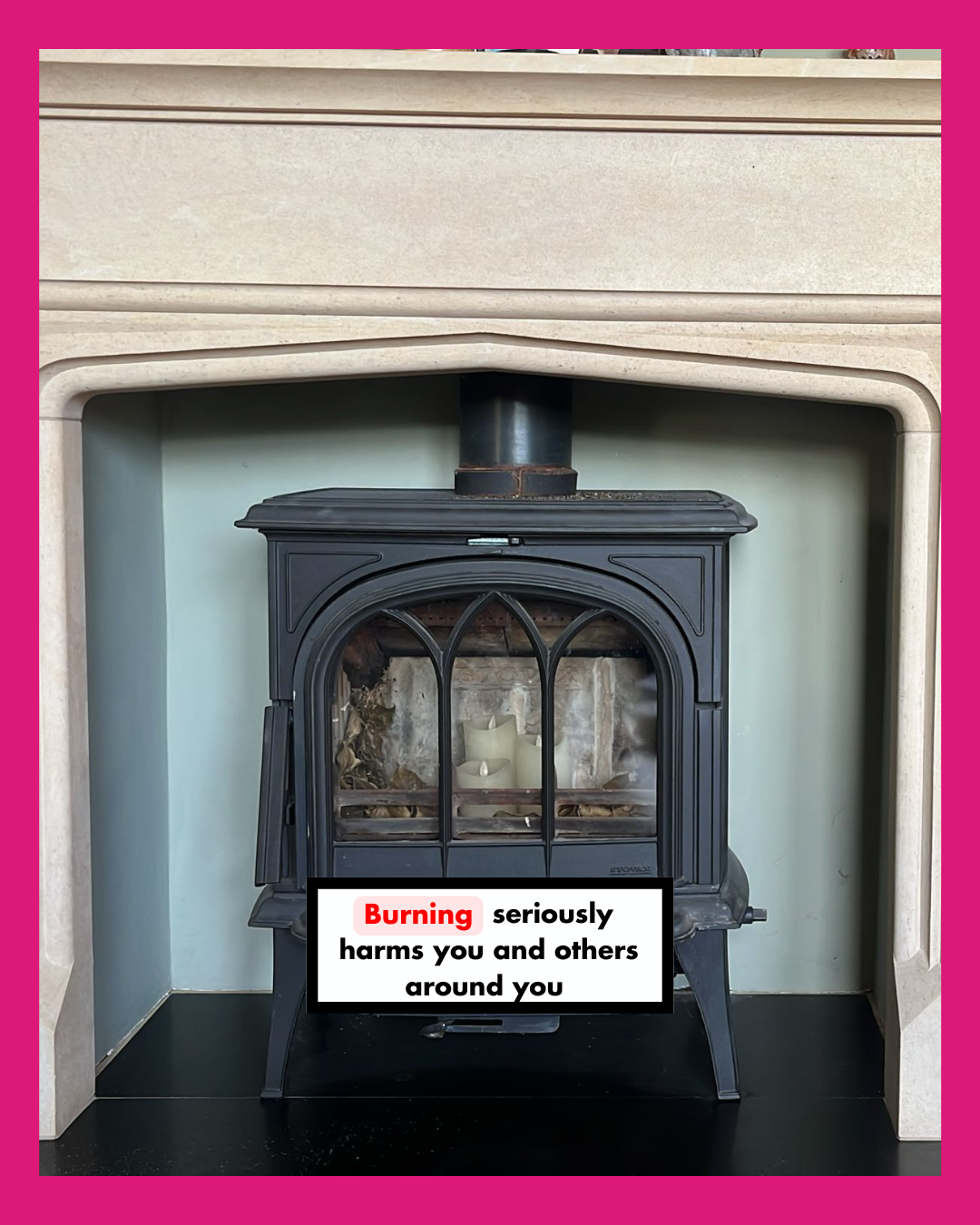
Similarities between wood and tobacco smoke
Wood smoke contains most of the same carcinogens as tobacco smoke, including formaldehyde, benzene and polycyclic aromatic hydrocarbons. Research shows that wood smoke is more toxic than cigarette smoke.
The packaging of tobacco products has contained health warning messages and images for many years now, to raise awareness of the harmful effects of smoking with the public.
We want to see wood burning stoves labelled as harmful, to better educate consumers, and an end to stoves being classified as “DEFRA-exempt” or “DEFRA-approved”, as this is misleading the public into thinking stoves are safe to use, in Smoke Control Areas or otherwise.
Do wood burning stoves cause cancer?
Lung cancer is on the rise globally among “never smokers”. This UCL study demonstrated for the first time how air pollution can cause lung cancer in people who have never smoked. Another UCL study discovered that lung function declined faster among solid fuel users compared to non-users. Between 10 and 20% of lung cancer diagnoses are made in those who have never smoked.
The US Sister Study found that higher wood stove / fireplace usage was associated with a 70% higher incidence of lung cancer. A second study of the same cohort showed that using an indoor wood burning stove or fireplace at least once a week was associated with a higher risk of breast cancer.
Air pollution from burning in UK homes contributes to nearly 2,500 premature deaths. Stopping non-essential wood burning in UK homes could help save the NHS millions of pounds and prevent thousands of deaths.
Burning wood is not carbon neutral
Image: @fhfpix via Unsplash
Per unit of energy, burning wood releases more carbon dioxide than coal or gas.
When wood is burned, the carbon dioxide that was absorbed over the years that the tree was alive is released back into the atmosphere immediately, along with short-lived pollutants such as black carbon. Regrowth and carbon reabsorption by trees can take decades, creating a carbon debt.
Research by Chatham House and others confirms that biomass combustion can be more harmful to the climate than fossil fuels over relevant timeframes for climate mitigation.

Graph taken from Global Action Plan’s Relight My Fire report on the cost of wood burning.
Burning wood is expensive
The yearly cost of using a new, Defra compliant stove for 20 per cent of a household’s heat, including purchase & installation, is 24 per cent higher than running a typical gas boiler. Even when using an existing stove, the yearly cost is 15 per cent higher than gas.
In almost every scenario, it is cheaper to heat your home using a gas boiler or a heat pump, not to mention less polluting and more efficient.
Newer stoves don’t solve the problem
From 2022, all new stoves sold in the UK had to meet tighter emissions standards under the Ecodesign Regulations. Yet, while using a more modern stove will can emit less than burning on an open fire, this does not solve the air pollution problem.
As this report shows, an Ecodesign stove has an estimated emission rate of six times the mass of PM2.5 than a diesel Euro 6 HGV (see figure 2 on page 18).
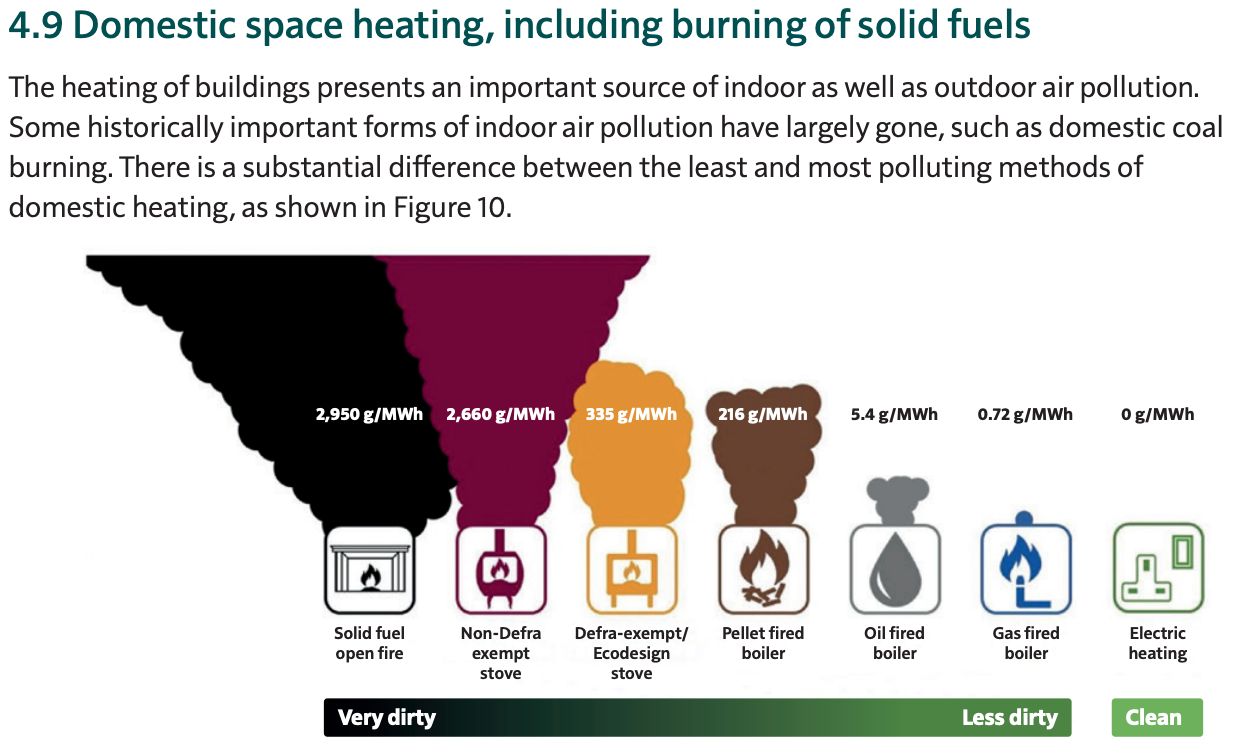
Image from Professor Whitty’s report showing comparative emissions from heat sources
A 2025 University of Surrey study found that multifuel Ecodesign stoves emit more ultrafine particles than a standard Ecodesign stove, and wood briquettes and smokeless coal increased ultrafine particle exposure by 1.7 and 1.5 times, respectively, compared to seasoned wood.
For modern stoves (including a Blue Angel stove), PM2.5 emission factors are higher for dry wood than for seasoned wood.
Chief Medical Officer Professor Chris Whitty’s 2022 air pollution report noted that Ecodesign wood burning stoves are several hundred times more polluting than gas central heating, and that “solid fuels are by far the most polluting method of domestic heating”.
What can I do?
Stop burning if you don’t need to
Please don’t burn if you have another form of heating. Can you only burn on special occasions if you can’t stop completely?
If you’re thinking about installing a stove…please don’t! Take a look below at a few examples of alternative options.


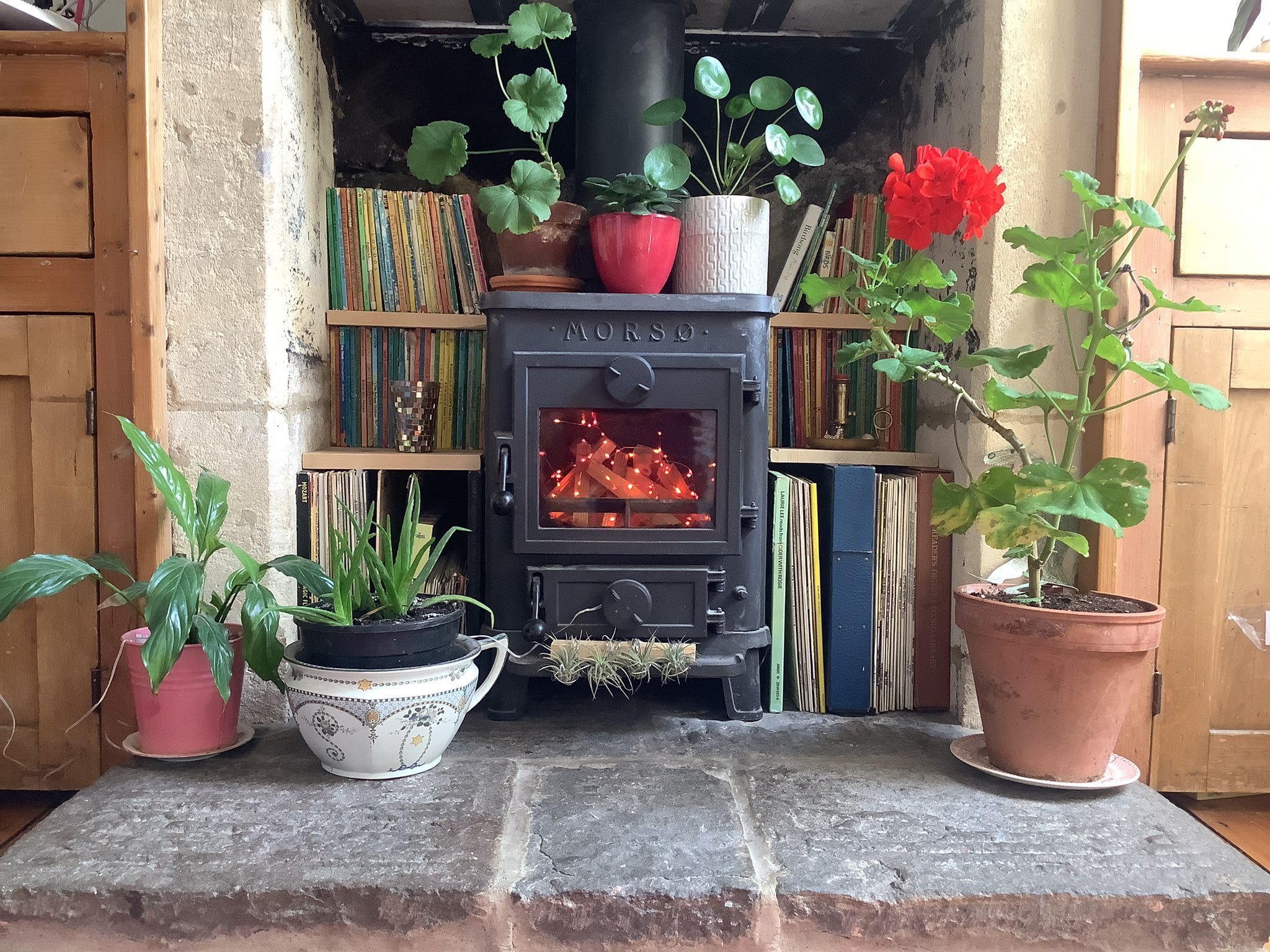

Images of fireplace alternatives, L to R: Matt White, Natalie Martin, Lily Hughes, @salbots
We run a social media campaign called #FireplaceFlip, to show that fireplaces or stoves can be beautiful without the flames. We’ve been sent some excellent ideas, including a stove that has been turned into a terrarium! If you have an alternative way to heat your home and don’t need to burn wood, your fireplace can still be a focal point, in an emission-free way.
Write to the media about wood burning
Interior magazines, television programmes and social media are full of images of living rooms with roaring fires or beautifully styled fireplaces and stoves. A stove is portrayed as a coveted purchase, and there is usually no awareness or acknowledgement of the amount of air pollution given off by burning wood and smokeless fuel.
If you read a newspaper or magazine or watch a TV programme that promotes wood stoves as a design feature, please bring our campaign to the attention of the magazine editor or broadcaster. We have a template letter that you can use to email them.
If you see burning portrayed as a good thing on social media posts, please leave a quick comment to explain that wood burning gives off a lot of pollution that is damaging our health.
Write to your local authority about wood burning
We write to all London and Greater Manchester councils every Autumn to ask them to raise awareness of the dangers of wood burning and to ask all residents not to use their stoves or fires unless they are the only source of heat. You can use our template letter to contact your council if you’d like to do similar.
Order our wood burning flyer

We have a flyer that you can order for free or download and print yourself. People across the country are using them to raise awareness of the impacts of wood burning.